Undergraduate degrees: B.A., B.S.
Undergraduate minor
Back… to Your Future
Have you ever imagined yourself as a medieval bard, composing manuscripts in a drafty cathedral garret? Medieval Studies provides an introduction to the Middle Ages (the period from 300 to 1500 A.D.), an important foundation of modern life and culture and a fascinating period in itself. The attractions of this time period are obvious: you will immerse yourself in the sophisticated humor of writers like Chaucer and the beauty of European architecture, as well as the lively appeal of medieval literature and culture.
As a Medieval Studies major, you will select your courses from a wide range of subjects like music, art, history, and religion, and will study with expert faculty members from across campus. Your studies may include Icelandic sagas, troubadours, castles and cathedrals, and the Crusades. The study of a range of languages is also part of Medieval Studies, and may include French, Spanish, German, Italian, and Russian, as well as such medieval languages as Old English and Middle Welsh in their original and translated forms.
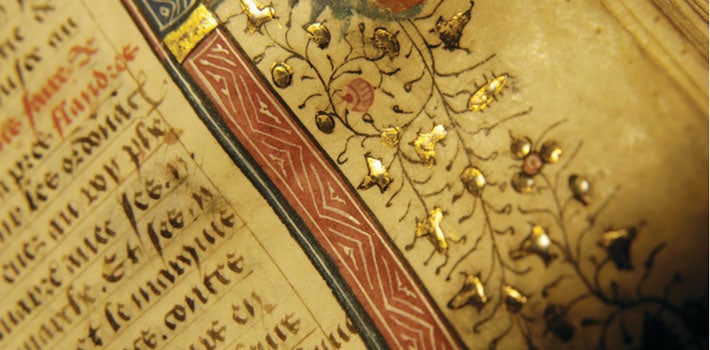
Interested undergraduates should declare a humanities major with the Medieval Studies option. The Special Collections Department of the University of Oregon Knight Library houses an impressive library of medieval manuscripts donated by Julia and Edward Burgess.
Points of Interest
- Discover the medieval world-view in Europe and beyond, and study the origins of the modern world with faculty members from diverse disciplines
- Explore life in the middle ages with classes from academic departments such as music, art, history, religion, and others
- Participate in special events like harp recitals, medieval poetry readings, and Medieval Day on campus
- Study in a medieval setting: Participate in the Cambridge University International Summer School in southeastern England
Sample Courses
- Collegium Musicum, Celestial harmony: Singing the Music of Hildegard Von Bingen focuses on abbess, visionary, writer, and composer Hildegard von Bingen, who stands as a unique figure in the history of medieval music. This course introduces students to singing Hildegard’s distinctive and varied repertoire within the context of the wider medieval chant tradition
- History of Western Architecture is a survey of architectural developments in the West, from prehistory to Gothic
- Old English is an introduction to the grammar of the language, with some coverage of Anglo-Saxon culture and literature
- The Inquisition begins with the inception of the first medieval tribunals in the thirteenth century, and covers the Spanish and Roman Inquisitions in the early modern period
- The Medieval Feast In Theory and Practice is an interdisciplinary course centering on a feast held at Barley Hall in York, England, in 1483. Students study the literature and meaning of medieval feasts, and analyze texts from romances to cookbooks. Coursework culminates in a reenactment of the feast
- 15th-Century Italian Long Sword, a physical education course, provides practice in longsword techniques
Student Work
Ken Aldrich was attracted to Arthurian and Robin Hood literature at an early age, so he was happy to find the UO’s Medieval Studies major. “I wanted to learn more about what life was truly like, and how that culture informed the literature of the time,” he says. With a double major in English and Medieval Studies, Aldrich found that some classes fulfilled credits for both majors. He really enjoyed the Old English language series, even learning to read Beowulf and the Dream of the Rood in their original language.
Michaela Rife spent a summer term in England at the Cambridge University International Summer School. “It is an entirely different and more rewarding way to study medieval subjects,” she says, “when you are walking through medieval streets every day and eating dinner in a 14th century dining hall. It is like living the subject matter.”
One of her classes centered on the letters of Abelard and Heloise. Rife says that discussing research topics with the professor, who authored the definitive biography of Abelard, was an incredible experience. “It is an amazing opportunity (though a little intimidating) to have a paper on a topic marked by one of the leading experts,” says Rife.
Selected Faculty Work
Martha Bayless is an associate professor of English. In Medieval Studies, she teaches the courses Old and Middle English, Medieval Latin, Oral Traditions in Ancient and Modern Culture, and The Medieval Feast in Theory and Practice, amon others. Her interests include the intersection between literature and culture in humor and comedy, and more serious realms.
Program Director Anne Laskaya is an associate professor of English. She specializes in Middle English literature and gender studies.
Gina Psaki is a professor of Romance Languages (Italian). She teaches medieval and Renaissance Italian courses. Her research and teaching interests include medieval and Renaissance Italian literature, and comparative medieval literature.
Stephen Shoemaker is an associate professor of Religious Studies. In Medieval Studies, he teaches courses in late antique and medieval Christianity. His research focuses on early devotion to the Virgin Mary, Christian apocryphal literature, and the relations between Near Eastern Christianity and formative Islam. He has received fellowships from the John Simon Guggenheim Memorial Foundation, the Alexander von Humboldt Foundation, the American Council of Learned Societies, and the National Endowment for the Humanities.
Richard Sundt is an associate professor of Art History. His research interests include Gothic architecture, especially the cathedral of Albi and the churches of mendicant orders.
Career Opportunities
Many professions value the creative minds and intensity of focus that are personifications of the Medieval Studies major. Graduates from this program go on to careers in teaching, law, journalism, museum work, and computer science.
Medieval Studies can be an area of specialization for students majoring in any of the related departments. Study abroad is strongly encouraged. This major also provides an excellent general education, or a solid base for graduate work in a more specialized area such as history or literature.
Contact Information
(541) 346-4069
(541) 346-4118 fax