Office of Admissions
Biochemistry

Department of Biochemistry and Molecular Biology

Undergraduate Majors: B.S. or B.A.
Undergraduate Minor

Learn in Cutting-Edge Labs

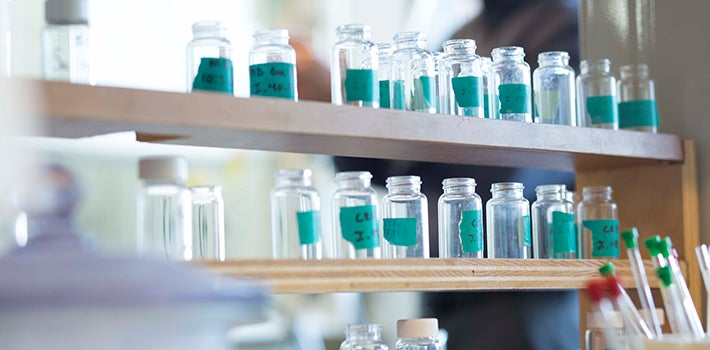
Biochemistry is the study of living things at the molecular level. As a biochemistry major at the University of Oregon, you will spend plenty of time in the lab, exploring the mysteries of mitochondria and biomembranes alongside faculty members doing important research.

You’ll learn in some of the most cutting-edge university labs in the country. The UO dedicated the multimillion-dollar Lorry I. Lokey Laboratories in 2008, and has invested millions of dollars on state-of-the-art equipment to furnish the underground facilities. Julie Haack, assistant head of the chemistry department, says the integrated science complex acts as a “high-tech extension service” by attracting a mix of researchers in government, industry, and from universities around the world.

Assist scientists making discoveries in neuroscience, physics, chemistry, and other disciplines. Rub elbows with experts in the nanofabrication facility, the X-ray diffraction lab, or the biooptics center.

On a green note: The University of Oregon is known worldwide for helping to develop green chemistry, a set of design principles that helps scientists to minimize the hazardous impact associated with materials and chemical processes on the environment. Work in labs where some of the best scientific researchers are keeping the environment front and center in their work.

While the biochemistry program is a recommended degree program for students who are interested in medical school, nursing, or other medical careers, a degree from the UO is specifically designed to train professional chemists and biochemists. Many doors open for those with an interest—and a degree—in biochemistry.

Points of Interest

  • The interdisciplinary nature of biochemistry research has resulted in a cross-pollination with modern genetic techniques and sophisticated chemical approaches. Biochemistry faculty members have close associations with the UO's Institute of Molecular Biology and Institute of Neuroscience
  • As a UO biochemistry major, you will have the opportunity to graduate with departmental honors by working on research problems for one academic year and receiving endorsement from a university faculty member
  • Embark on a career in industry or government, or enter graduate-level studies. The biochemistry program is a stepping stone for students seeking admission to health profession careers
  • The UO chemistry department practices green chemistry, which focuses on reducing, recycling, or eliminating the use of toxic chemicals in chemistry by finding creative ways to minimize the human and environmental impact without stifling scientific progress

Sample Courses

  • Physiological Biochemistry is a course geared toward preprofessional health science students. Topics include protein structure and function, enzyme mechanisms, central metabolism and bioenergetics, and the integration and regulation of metabolism by hormone action
  • Biochemistry examines the structure and function of macromolecules, metabolism and metabolic control processes, mechanisms and regulation of nucleic acid, and protein biosynthesis
  • Organic Chemistry looks at the structure, properties, and bonding of organic molecules, reactions and mechanisms of organic chemistry, and the organic chemistry of biomolecules, with a focus on chemical aspects
  • Physical Chemistry incorporates methods of physics applied to chemical problems, including inorganic, organic, and biochemistry. Introduction to chemical thermodynamics, rate processes, and quantum chemistry are topics that are covered

Practical Learning

As a biochemistry major, you’ll have a host of options for real-life learning. Work in the university’s laboratories, where you’ll assist professionals performing high-level experiments in nanotechnology, neuroscience, and other disciplines. Or participate in the NanoNet program. NanoNet allows K–12 teachers to design experiments that they couldn’t perform in their classrooms. Then, the UO, with the help of its students, connects these far-flung classrooms to the UO labs via the web. You can help kids get hooked on science in a big way.

Interdisciplinary Opportunities

Because the biochemistry major is part of the Department of Chemistry, interdisciplinary opportunities in the program abound. You can choose to minor in biology, business, computer and information science, exercise and movement science, economics, environmental studies, geological sciences, mathematics, or physics.

Undergraduate research opportunities are available with faculty members in biology, molecular biology, neuroscience, chemical physics, physics, and geology. Study with professors who are leaders in their field of expertise.

Student Work

Biochemistry major Peter Kim has been working in the molecular biology labs, helping research the mouse genetic mosaic system. The team is trying to discover the mechanisms that lead to the very earliest stages of brain tumor formation. Kim, who was also a teaching assistant for organic chemistry, says the UO offers undergraduates more than just classroom time. “In our school, there is a research environment that’s really accessible to students. And the teachers are incredible.”

Stephanie Rawlings works in an Institute of Neuroscience lab. Her mission: help fit different pieces of DNA together to make a transgenic mouse. Rawlings revels in the experiences on campus, and says the biochemistry major is a good fit for her interests. “I like thinking about things on a cellular level,” she says. Rawlings has been accepted for a summer internship program with the innovative Stowers Institute for Medical Research in Missouri, studying fruit flies and how cells develop based on their DNA.

Selected Faculty Work

The main focus of Associate Professor Andy Berglund’s research is to an understanding of the molecular basis of the human disease myotonic dystrophy, the most common adult form of muscular dystrophy. Specifically, his work looks at the mechanisms regulating pre-mRNA splicing, since incorrect splicing causes a variety of diseases. In another area of research, the lab is exploring the use of RNA in the synthesis of nanomaterials. Berglund is a member of the Institute of Molecular Biology.

Associate Professor Kenneth Prehoda’s research focuses on the biochemical processes that allow cells to respond to changes in the environment. Part of his research program involves determining structures of protein complexes using X-ray crystallography or nuclear magnetic resonance.

Professor Victoria DeRose is an inorganic spectroscopist who investigates chemical activity and structure in nucleic acids and proteins with an emphasis on metal interactions. Her work is innovative in its interdisciplinary effort to use tools of biological and bioinorganic chemistry and spectroscopic methods to examine biological and chemical processes that are extremely difficult to study with conventional methods. Her research promises far-reaching impact on our understanding of fundamental biological and chemical systems. She is the recipient of a UO Faculty Excellence Award.

Professor Tom Stevens is known for his work in the field of vacuolar protein sorting in yeast. He has been awarded grants for his research in sorting and transport of yeast membrane proteins and the study of cell biology of eukaryotic organelle assembly. His findings have been widely published in scientific journals. Stevens has been called one of the very best cell biologists or biochemists of his generation. He was awarded a Philip H. Knight Professorship, has won a College of Arts and Sciences Distinguished Professor Award, and received numerous other awards during his career at the UO.

Career Opportunities

As a biochemistry major, you’ll have a host of opportunities after graduation. The degree is a good choice if you’re planning to enter a profession in the health sciences such as medicine, dentistry, clinical chemistry, biotechnology, genetics, pharmacology, physiology, or toxicology, and is also useful in related fields such as forensic science and cell biology. Industrial employers include chemical companies, food processing plants, drug manufacturers, cosmetics companies, and agricultural chemical companies. In addition, research-oriented biochemists work in hospitals, universities, and both governmental and private research labs. You might work as an environmental advocate or a policy adviser, or evaluate biotechnology companies for investors.