Undergraduate Anthropology degrees: B.A, B.S.
Undergraduate Anthropology Minor
Human Experience: Culture, Prehistory, and Biology
At the UO, the Department of Anthropology is divided into cultural, physical, and archaeological studies. While the curriculum requires students majoring in Anthropology to take courses in all three categories, you can focus your studies in the area that most interests you.
Maybe you’re like Margaret Mead, interested in how the cultural details of a group—how they speak, what they eat and wear, what they do to survive and endure—distinguish the group as a culture. Anthropology at the UO has an impressive group of cultural anthropologists who study groups in places like Papua New Guinea, Central and South America, Eastern Europe, and the South Pacific.
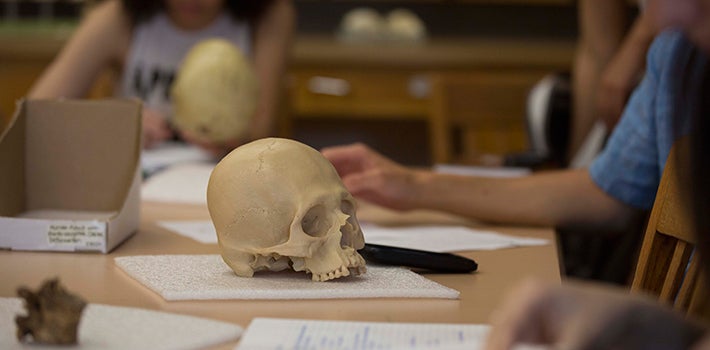
Maybe you’re more like Jane Goodall, interested in the physical aspects of anthropology. In this area, you study issues of evolution and science. We have specialists in primate behavior and in human and primate skeletal studies. Students have supervised access to the physical anthropology lab that stores dental collections from South Asia and other skeletal models for study.
Or perhaps you’ve always wanted to be a real-life Indiana Jones, hunting for ancient relics and artifacts. The archaeology program at the UO is renowned for its work in Northwest archaeology, Pacific Islands archaeology, and digs in the California Channel Islands. The UO offers a summer field school where undergraduates work on digs in Western and Central Oregon, camping out for six weeks while surveying and hunting for artifacts. Collected materials are analyzed in the archaeology lab at the UO, where students identify and document findings. This is hands-on learning at its best.
The UO anthropology department offers an award-winning faculty, fascinating classes, and a curriculum that allows students to explore and focus within this broad topic. Once you decide which of the three areas interests you most, an adviser will help you plan your academic path and serve as an invaluable source of knowledge about what to do with your anthropology major in the professional world.
Points of Interest
- Courses offered by the Department of Anthropology span the natural sciences, social sciences, and humanities, and provide a broad understanding of human nature and society
- Archaeology students analyze and document artifacts from actual project sites such as Tecolote Canyon and the San Juan Islands
- The UO’s Department of Anthropology is actively affiliated with the Northwest Primate Conservation Society and the Southwest Oregon Research Project (SWORP), which involves the repatriation of 110,000 archival documents to forty-four Tribal Nations in the greater Oregon area
- The UO has several advanced laboratories for teaching and research in archaeology, cultural anthropology, and physical anthropology
Sample Courses
- Native North Americans provides an introduction to past and contemporary Native American peoples, the historical experiences of Indian peoples, and a meaning-centered approach to understanding human differences
- Primates in Ecological Communities explores the varied interactions of primates with fellow primates, other kinds of animals, and various plants in tropical communities, while considering ecological roles played by primates in these settings
- Food and Culture takes an anthropological approach in looking at the role of nutrients in human development (individual and group); cultural determinants and differences among populations; world food policy; and applied nutritional anthropology
- Northwest Coast Prehistory looks at archaeological and prehistoric cultural development of peoples indigenous to the Northwest Coast of North America, from Alaska to northern California, from earliest settlement through Western contact
Hands-on Learning
The Archaeological Field School allows you to gain practical skills. In the summer, you'll pack up for six weeks and head out to various sites in Western and Central Oregon. Student-faculty research teams have carried out major archaeological studies in the Great Basin desert area east of the Cascade Mountains.
Cultural anthropology students also have a chance to do research projects in the field. Professor Lynn Stephen recently had students join her to observe the conditions of migrant farm workers in Western Oregon.
Student Work
Alec Zimmerman knew that she wanted to be an anthropologist when she was in the fifth grade. “I wanted to be the next Jane Goodall,” she says.
Fast-forward to present day, Zimmerman is still excited by anthropology. During her time at UO, she has been a member of the Northwest Primate Conservation Society, an on-campus group whose mission is to support and conserve primate populations throughout the world. She also studied abroad at La Suerte Biological Field Station in Coast Rica.
Zimmerman has volunteered with the Committee in Solidarity with the Central American People, a local grassroots organization that hosts presentations and talks to expose students and community members to new ideas about human-rights concerns in Central America. In addition, Zimmerman has served as co-director of the on-campus animal-rights group, Students for the Ethical Treatment of Animals. “Our goal is to influence change and inspire people,” she says.
Zimmerman’s academic interests shifted into the realm of immigration and immigrants’ rights. She was surprised that while her interests were changing, she could still apply her studies in anthropology toward her new pursuits. “I’m really interested in human rights and immigration, animal rights, LGBTQ issues,” she says. “It’s incredible what you can do with an anthropology major.
Selected Faculty Work
Professor William S. Ayres has been a professor at UO since 1976. His research interests include the development of chiefdoms and early food production, especially in the Pacific Islands (Micronesia, Polynesia) and in Southeast Asia. He is continuing archaeological investigations at Pohnpei’s Nan Madol site, known for its massive stone architecture. Ayres uses computer graphics to facilitate architectural reconstruction and is engaged in provenance studies of archaeological materials, especially stone building resources and ceramics through geochemical analysis.
Professor Jon M. Erlandson is an archaeologist who specializes in western North America, with a focus on the archaeology of maritime societies of the Pacific Coast of North America, the Pacific Rim region, and the world. His research and teaching interests include the development of maritime societies, historical ecology in coastal environments, human evolution and migrations, the peopling of the Americas, the history of seafaring, traditional technologies, dating methods in archaeology, geoarchaeology, cultural resource management, and collaborative research with indigenous communities.
Professor Geraldine Moreno-Black has been a professor at UO since 1974. She specializes in nutritional anthropology, biological anthropology, human ecology, and gender issues. She is also actively engaged in field work in Thailand and Laos, and has recently co-authored a book: The Lao: Gender, Power, and Livelihood.
Lynn Stephen is Distinguished Professor and former chair of the Department of Anthropology at the University of Oregon. She is the author of four books and her research focuses on gender, ethnicity, political economy, social movements, human rights, and nationalism in Latin America. She is currently working on two projects involving immigration and Mexican farmworkers in Oregon, and the role of cooperatives and global marketing on the political, labor, and gender identities of Zapotec women in southern Mexico.
Career Opportunities
With a major in anthropology, you can use your cultural knowledge to act as a liaison between different groups of people. You can take your background in migrant farm worker conditions and apply it toward a career in immigration law. You can use physical anthropology knowledge to observe how culture, diet, and even religion can affect the human body. Archaeology students can use their skills in construction work; there is often a need to call in archaeologists and surveyors when land is being developed. Another option is to pursue a teaching certificate after completing your degree, and teach science or social studies at the secondary level.